

Beginner Hangboard Training for V3 Climbers
Last Updated: November 5, 2026
Quick Summary
Beginner hangboard training for V3 climbers should start only when you climb regularly, recover well and have no finger symptoms. Begin with one low-load session per week using a large edge, an open-hand grip and feet support; keep hangs controlled and stop before your grip fails.
- Start with 3 hangs of 5 seconds in Week 1.
- Rest at least 2 minutes between hangs.
- Use the same large edge and foot support throughout the four-week plan.
- Stop for sharp pain, new tenderness or a change in how you grip.
Table of Contents
- Beginner hangboard training for V3 climbers: check readiness first
- Choose hangboard grip positions for beginners
- How often to hangboard and how long each workout should last
- A beginner hangboard routine for V3 climbers
- Combine hangboard sessions with climbing and choose your setup
- Frequently Asked Questions
Beginner hangboard training for V3 climbers: check readiness first
Beginner hangboard training for V3 climbers should start with readiness, not a grade alone. This guide explains how to check your base, choose easy grip positions and add finger training without letting it crowd out climbing. The goal is steady, pain-free practice, not a quick jump to smaller holds.
Hangboard training is focused finger-strength practice on fixed holds. For a V3 climber, the safest starting point is usually a large edge, feet-assisted hangs and low training volume.
Readiness beyond climbing grade
A V3 grade can describe your climbing, but it cannot tell you whether your fingers are ready for added load. Look at your climbing experience, recent finger health and ability to follow proper technique. If you’re new to climbing, still learning basic footwork or often sore after sessions, build skill and general strength first.
Use this readiness check:
- You climb regularly and recover well between sessions.
- Your fingers feel normal during and after climbing.
- You can keep your shoulders engaged in a controlled hang.
- You can stop before your grip fails.
A common mistake is treating a climbing grade as a green light. It isn’t.
When to wait and what to do instead
Wait on hangboarding if finger pain, swelling or lingering soreness is present. Focus on climbing technique, easy routes, footwork and general strength instead. If pain persists or affects daily tasks, stop loading the finger and seek advice from a qualified health professional.
For more guidance on timing, read when to start climbing training.
Choose hangboard grip positions for beginners
For beginner hangboard grip positions, start with a comfortable open-hand grip on a large, rounded edge. Keep the load light and your shoulders active; save half-crimp work for later, once you can hang with control and no pain. Easy technique beats a harder hold done poorly.
Select an edge and set your body position
Choose an edge with enough depth for your fingers to rest securely. Keep your body still, shoulders gently engaged and elbows soft. Use a feet-assisted hang by keeping some weight on the floor or a step.
- Start with open-hand grip, not a full crimp.
- Keep both hands in a natural position.
- Step down if you swing or lose control.
- Stop before failure; don’t hang until your grip slips.
A common mistake is choosing a small edge because it looks like “proper” training. It only adds load. Before your first session, follow this guide to warm up fingers before climbing.
How often to hangboard and how long each workout should last
For a V3 climber who meets the readiness checks above, begin with one low-load session per week, not a second finger workout added on top of every climbing day. Keep the first sessions short and stop well before your grip fails. The aim is to practise controlled loading while keeping enough recovery for climbing, not to find your maximum.
A conservative first-session template
After a general warm-up and easy climbing or movement, use a large, comfortable edge and an open-hand grip. Keep your feet on a step or the floor so you can reduce the load at any moment.
- Do 3-5 hangs of 5-7 seconds.
- Rest at least 2 minutes between hangs; take longer if your breathing or grip has not settled.
- Keep the effort easy to moderate: finish each hang feeling you could have held longer.
- End the session if you cannot keep your shoulders engaged, your body still and your grip consistent.
These are conservative starting parameters, not a test or a guarantee of safety. If even a feet-assisted hang feels strenuous, use more leg support or skip the hangs and continue with easy climbing instead.
Set the weekly frequency around recovery
If your next climbing session feels worse, or you are still sore when it begins, remove the extra finger training rather than trying to make up missed hangs. Consistency at a tolerable dose is more useful than increasing frequency before your recovery supports it.
Mountain Rocks Portable Pull-Up & No Nail Hangboard Training Bundle | Wildwood →
A beginner hangboard routine for V3 climbers
A V3 grade alone does not determine readiness for hangboarding: climbing history, finger health, consistency and controlled form matter too. If you pass the readiness check, have no current finger symptoms and can keep a feet-assisted hang controlled, use this four-week introductory plan as a cautious way to practise loading. It is deliberately low volume and does not require maximum hangs or small edges.
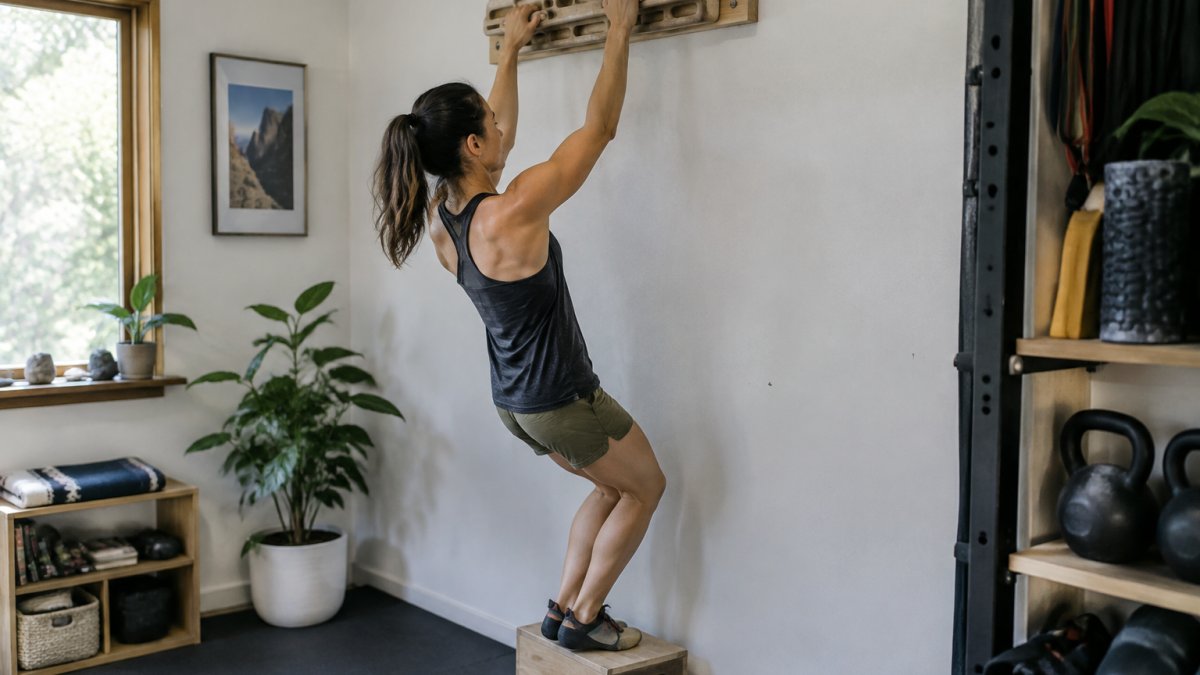
The four-week plan
Train once a week, on a day when you are fresh enough to maintain good form. Choose one large, comfortable edge and use an open-hand grip throughout. Keep your feet supported so you can control how much weight your hands take.
| Week | Work | How to perform it |
|---|---|---|
| 1 | 3 hangs of 5 seconds | Use generous foot support; practise a quiet, controlled position. |
| 2 | 4 hangs of 5 seconds | Repeat only if your fingers felt normal during the week after Week 1. |
| 3 | 4 hangs of 6 seconds | Keep the same edge and foot support; change only the hang duration. |
| 4 | 4 hangs of 6 seconds | Repeat the previous dose and assess recovery rather than adding difficulty. |
Rest at least 2 minutes between hangs, and take longer whenever you need it. Warm up with general movement and easy climbing first; do not use the first loaded hang as your warm-up. Keep the effort submaximal, with no slipping, shaking or forced final seconds. The schedule is a starting framework, not a requirement to progress every week.
Progress only when the current dose is comfortable
Watch out: If your feet come off unexpectedly, your shoulders lose control or your grip starts to open, the load is too high for that hang; step down and make the next attempt easier rather than fighting to finish.
Regress, pause or stop when needed
Record the edge, grip, foot support, hang time and how your fingers feel later that day and the following morning. That record helps you distinguish a genuinely tolerable progression from a session that only felt manageable in the moment. If you cannot access a board, keep building climbing skill and general strength rather than improvising on an unsuitable edge; hangboarding is optional, not a prerequisite for progressing beyond V3.
Combine hangboard sessions with climbing and choose your setup
For setup ideas, see our beginner hangboard guide.
Stop for pain and allow recovery
Stop if you feel sharp pain, new tenderness or a change in how you grip. Don’t train through finger pain to complete a plan. Rest, and seek qualified advice if symptoms continue.
Choose portable or mounted equipment
MOUNTAIN ROCKS offers portable wooden hangboards with four edge depths. Browse portable hangboards, or read about hangboards for small apartments.
The challenge is adding finger strength without turning every climbing week into a test. MOUNTAIN ROCKS offers portable hangboards and a no-drill doorway bundle with wooden grips for home or travel training. Get started with MOUNTAIN ROCKS.
Frequently Asked Questions
Should V3 climbers start hangboarding?
A V3 grade alone does not establish readiness.
How often should a beginner climber hangboard?
Start with one low-volume hangboard session per week, leaving recovery time before another finger-loading session. Track how your fingers feel during and after training, and avoid stacking a hard hangboard workout beside demanding climbing sessions. The beginner hangboard routine should stay easy enough to complete with controlled form, not continue to failure.
What grip should beginners use on a hangboard?
The Wildwood Go portable set has four edge depths, including a 25mm edge described for warm-ups and beginner climbers.
How long should a beginner hangboard session last?
Keep the first hangboard workout short: warm up properly, then complete a small number of controlled, assisted hangs with full rest between efforts. Stop while your grip and body position remain steady, rather than extending the session to exhaustion. There is no single duration in the supplied research that suits every beginner, so record your session and increase training volume gradually only when recovery remains comfortable.
Climbing Wall Association training resources
Australian Institute of Sport injury prevention resources
University of Queensland climbing injury research
