

Which Indoor Climbing Holds Are Worth Buying?
Last Updated: November 14, 2026
Quick Summary
The best indoor climbing holds for home training are a mix of shapes, including jugs, crimps, slopers, pinches, pockets and edges, with roughly half large positive holds. Pinch sets suit climbers who only pull on jugs and edges, and a single well-made mixed set beats a pile of mismatched holds.
- Most indoor climbing holds fall into jugs, crimps, slopers, pinches, pockets and edges.
- A practical starter ratio is about half large positives, a quarter mid-size edges and pinches, and a quarter small crimps.
- Mountain Rocks pinch set includes 15 pinches in three sizes, made from beechwood.
- Buy roughly one hold per 0.3 to 0.5 square metres of usable wall area.
- Mount holds on 18 mm structural plywood with T-nuts on a 200 mm grid.
Table of Contents
- Types of Climbing Holds and Which Ones Suit Home Training
- Climbing Holds for Training Board Use: Mountain Rocks Pinch Holds Reviewed
- Climbing Hold Installation and Closing Advice on Buying Your First Set
- Frequently Asked Questions
Types of Climbing Holds and Which Ones Suit Home Training
Most indoor climbing holds fall into a handful of shapes: jugs, crimps, slopers, pinches, pockets and edges, and each asks something different of your fingers.
Jugs are big, positive holds for warm-ups and beginners; crimps are small fingertip edges that load tendons hard; slopers are rounded and rely on friction; pinches train thumb opposition; pockets take one to three fingers; edges sit between a jug and a crimp. Size and orientation matter as much as shape, a 20 mm crimp differs greatly from a 10 mm one, and rotating a hold or moving it to a steeper section adds difficulty without buying new holds.
A practical starter ratio is roughly half large positive holds, a quarter mid-size edges and pinches, and a quarter small crimps, slopers and pockets.
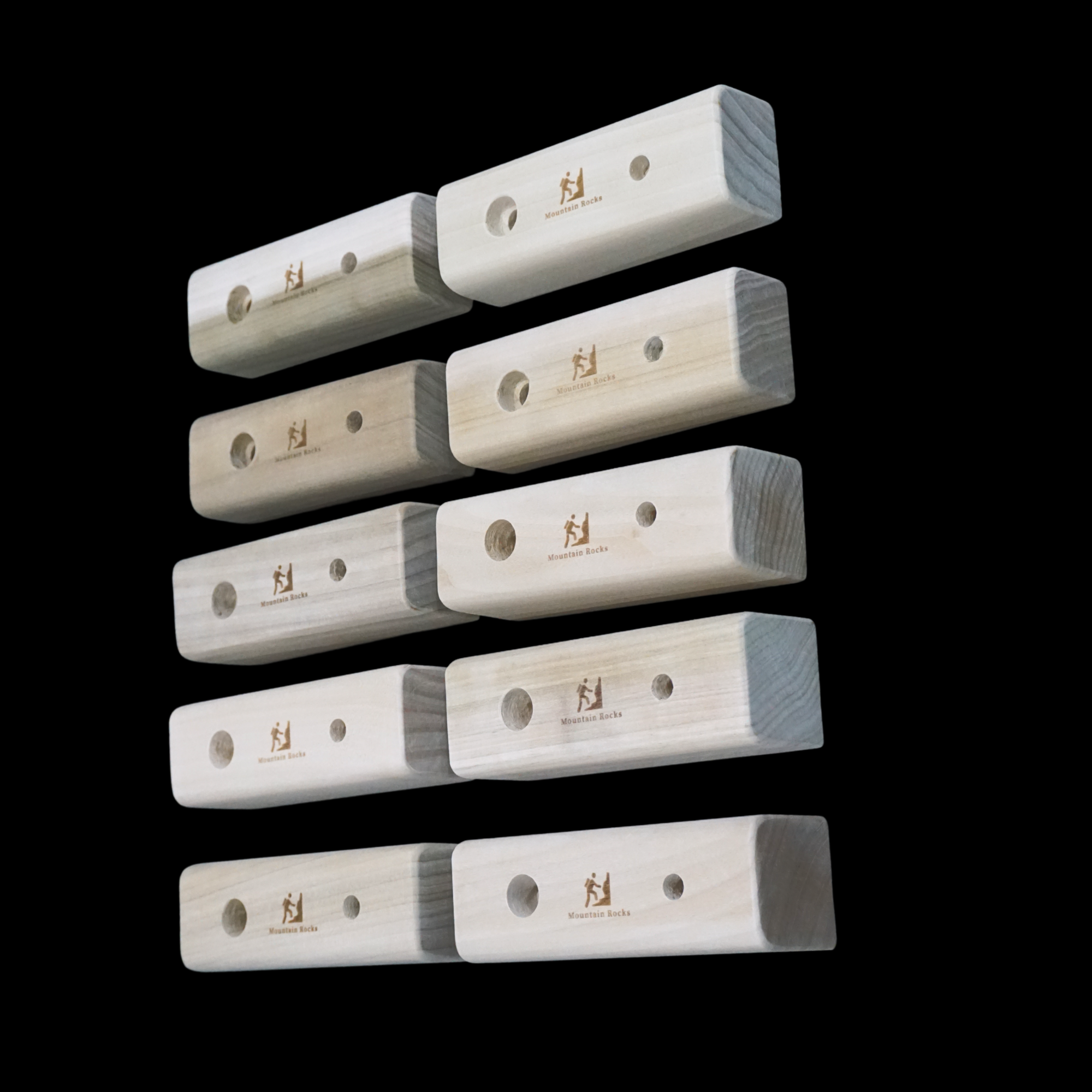
Pinches are where many home climbers start, because they build controllable grip strength. The Mountain Rocks 10 Piece Wooden Rock Climbing Pinch Holds include five pairs in three sizes, 15 pinches in total, made from quality beechwood with a polished surface. You can see the full pinch set here before deciding.
The Premium Wooden Rock Climbing Hangboard Hb2100 includes jugs, slopers and edges on one board, covering several hold types at once. Browse the hangboard options to compare sizes.
Climbing Holds for Training Board Use: Mountain Rocks Pinch Holds Reviewed
A pinch block trains a grip many routes demand, filling a real gap for climbers who only pull on jugs and edges.
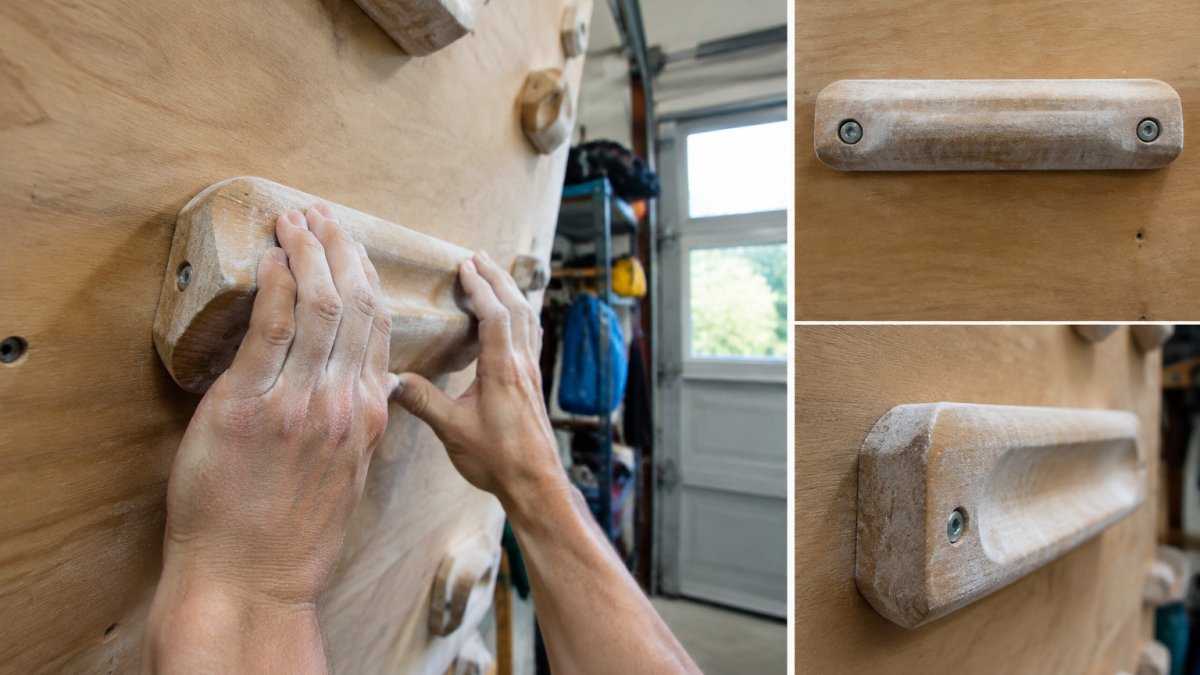
The Mountain Rocks pinch set is beechwood with polished edges, designed to mount on a wooden or concrete wall with bolts and screws included. It offers fewer shapes than a larger board, so it works best as a supplement. A standalone pinch block is an option if you only want that one shape.
Climbing Hold Installation and Closing Advice on Buying Your First Set
Installing holds properly is the difference between a wall you trust and one you quietly stop using.
1. Frame the wall. Most home walls use timber studs at 400-600 mm centres, braced so the panel cannot flex, typically 70 x 35 mm or 90 x 45 mm structural pine. Keep the frame square and plumb before sheeting.
2. Sheet with plywood. Use 18 mm structural plywood, screwed to the studs at 200-300 mm centres. Thinner panels flex more and hold bolts less securely. Seal or paint the face so chalk and rubber do not stain the timber.
3. Plan T-nut placement. Drive T-nuts into the back of the plywood before the panel goes up, on a 200 mm grid (or tighter 150 mm on a small wall). Check each sits flush and does not spin, and mark the grid on the front so you can find the nuts after painting.
4. Choose bolts and screws correctly. Most commercial holds fix with a socket-head cap screw into a T-nut, typically M10 for larger holds and M8 for smaller ones, matched to hold depth plus panel thickness. Small footholds use countersunk wood screws direct into the plywood. Never overtighten, crushing the hold or stripping the T-nut is a common failure.
5. Load and safety. A home wall carries dynamic load every time someone falls, so fixings, frame and panel must be rated for it; have a builder or engineer check the frame if unsure. Watch out: a T-nut that pulls through, a spinning nut, or a bolt that bottoms out means the hold is not secure, fix it before climbing.
6. Set the first layout. Start with jugs and large edges low and on vertical sections, and place smaller crimps and slopers where the wall is steeper. Space holds within comfortable reach, group colours into rough routes, and leave gaps to add holds later.
Buying your first set. Measure the usable wall area, then buy holds at roughly one hold per 0.3-0.5 square metres, leaning toward higher density on small walls. A single well-made set of mixed shapes beats a pile of mismatched holds. Check that holds suit your panel thickness and bolt size, and confirm hardware is included. When ready, explore the home climbing wall holds range and compare what fits your space and budget. Mountain Rocks offers free shipping and fast dispatch.
The installation steps below set out the key fixing details and checks for a home climbing wall.
| Step | What to do | Time or frequency |
|---|---|---|
| Frame the wall | Brace studs square and plumb | Studs at 400-600 mm centres |
| Sheet with plywood | Screw 18 mm structural plywood to studs | Screws at 200-300 mm centres |
| Plan T-nut placement | Drive T-nuts into the plywood back | 200 mm grid (150 mm on small walls) |
| Choose bolts and screws | Match fixing to hold and panel depth | M10 for larger holds, M8 for smaller |
| Load and safety check | Confirm fixings and frame are rated | Check before climbing |
| Set first layout | Place jugs low, crimps where steeper | Leave gaps for later holds |
Frequently Asked Questions
What types of holds are best for a home climbing wall?
For a home wall, a mix of jugs, crimps, slopers and pinches gives the most useful training. Jugs are large and forgiving, so they suit beginners and warm-ups. Crimps and pinches build finger strength and are better once you have a solid base. Slopers train balance and grip on rounded surfaces. Mountain Rocks' 10 Piece Wooden Rock Climbing Pinch Holds ($80.00 AUD) provide three sizes per pair, so you can build a range of problems from the one set.
How do you attach climbing holds to a home climbing wall?
Most holds are fixed with bolts or screws into the wall surface, using the hardware supplied with the set. Wooden or concrete walls are generally suitable, as long as the mounting points are solid. Mark your layout first, drill pilot holes at the correct size, and tighten each fixing until the hold no longer moves under load. Check the fixings periodically, especially on a training board that gets heavy use.
Are wooden climbing holds better than resin for indoor use?
Wooden holds offer a natural feel and a comfortable grip, and they suit home walls well. The Mountain Rocks pinch set is made from quality beechwood with polished edges, which keeps the surface comfortable to hold. Resin holds offer different textures and shapes. For a home training board, choose based on the grip you want to train and the surface feel you prefer.
